Wednesday, July 6, 2011

Half-Broke Horses by Jeannette Walls

Summary (courtesy ofGoodReads):   Lily Casey Smith, this novel's feisty Texas protagonist, is a frontier teacher, a rancher, a rodeo rider, a poker player, and bootlegger. In Half Broke Horses, she survives droughts, tornados, floods, poverty, a bigamous husband, and whatever else fate can throw against her. Based on author Jeannette Walls's grandmother, Lily is a plausible character because she has a voice that synchronizes with her history.

And here's what I thought:   Actually, the above summary doesn't quite do this book justice.   This is a great book, based on the author's own grandmother --- and she's quite the character.

If you have already read Walls' nonfiction book, The Glass Castle, then you might remember the bits about her grandmother that were in that story.   If not, that's okay -- this book introduces you to Lily as a child, and takes you through her life, growing up on a ranch, going to Chicago, and then returning to ranching as an adult.   Lily's not your usual grandmother (at least, probably not the usual grandmother stereotype we sometimes think of) --- she's a formidable force of nature, horse-training, rancher and teacher.  As I said, Walls based the book on her real-life grandmother, so much of the story comes from reminisces, but Walls does use her imagination to fill in a bit.  The story is told first-person, so we experience everything through Lily -- and she makes for a pretty interesting narrator.   Lily is pretty unflappable, taking what comes in stride, and always figuring out the best way to handle situations.  She's clever and inventive, and never gives up -- she's one tough cookie.   Which is not to say that she's not likeable; she is, and she's got a sense of humor.  Will you find this book funny?  I did at times, especially because of Lily's humor is wry at times (which I like).   

It's interesting to think about women like Lily, women who weren't afraid to speak their mind, and go their own way, even when it wasn't common for women to do so.  At the age of fifteen, Lily left the family ranch to take a teaching job 500 miles away -- and she rode there on her horse, camping out along the way.  She learns how to drive one of the first cars, and later, takes flying lessons.  When faced with drought, or tornadoes, tragedy, or even prejudice, Lily stands tough and tall.  She's the kind of woman that doesn't necessarily makes the history, but still influences history, all the same.  The fact that the story takes us through her life, with her telling us her story, makes it more interesting that I think a nonfiction book about Lily would have been.   Walls is a top-notch author, and her writing is strong and fluid, with an even pace.  I had enjoyed The Glass Castle quite a bit, so I had high hopes for this book -- and I wasn't disappointed.


First sentences: Those old cows knew trouble was coming before we did.  It was late on an August afternoon, the air hot and heavy like it usually was in the rainy season.  Earlier, we'd seen some thunderheads near the Burnt Spring Hills, but they'd passed way up to the north.   I'd mostly finished my chores for the day and was heading down to the pasture with my brother, Buster, and my sister, Helen to bring the cows in for their milking.  But when we got there, those girls were acting all bothered."

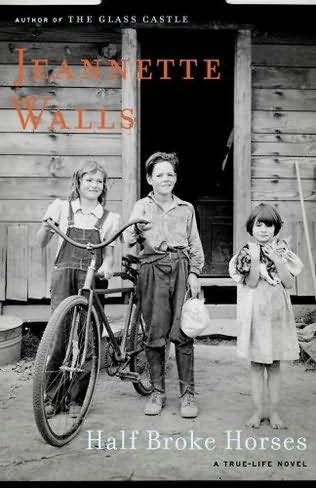
Thoughts on the cover:  The children on the cover are not Lily and her siblings -- it's a photo by Dorothea Lange.  However, it does fit with the story, and I like Lange's photography, so I thought it was eye-catching and a good match to the story.

Friday, July 1, 2011

Wallaby says ..... time to Hop!

We've reached another Friday (and a three-day weekend for some of us) -- and that means it's time for the Book Blogger Hop.  Hosted, as always, very nicely, by Jennifer at Crazy for Books, the Hop is a weekend-long event that allows us to visit blogs, learn new things, discover more books to read.....   and provide a great excuse to stay in the air conditioning this weekend.

This week's question comes from Sue who asks: What keeps you reading beyond the first few pages of a book, and what makes you stop reading a book and put it back on the shelf?"

When I put a book back on the shelf -- it's because, in a word: annoyance.   Annoyance is usually what makes me put a book back on the shelf .   It can be that the plot's just not catching me, but most of the time, it's because I don't like a character or care enough about them to keep reading, or I find the writing style to be irritating.   Sometimes, I just get bored and put it back, but most of the time, it's because something about the book that's getting on my nerves.

It's almost easier to identify why a book gets put back than to figure out what keeps me reading.  Writing style, flow, storylines, characters --- when it all comes together, it keeps me turning the pages.

Happy Hopping, everyone! 

Thursday, June 30, 2011

The Storm at the Door by Stefan Merrill Block

Summary (courtesy of GoodReads):  
The past is not past for Katharine Merrill. Even after two decades of volatile marriage, Katharine still believes she can have the life that she felt promised to her by those first exhilarating days with her husband, Frederick. For two months, just before Frederick left to fight in World War II, Katharine received his total attentiveness, his limitless charms, his astonishing range of intellect and wit. Over the years, however, as Frederick’s behavior and moods have darkened, Katharine has covered for him, trying to rein in his great manic passions and bridge his deep wells of sadness: an unending project of keeping up appearances and hoping for the best. But the project is failing. Increasingly, Frederick’s erratic behavior, amplified by alcohol, distresses Katharine and their four daughters and gives his friends and family cause to worry for his sanity. When, in the summer of 1962, a cocktail party ends with her husband in handcuffs, Katharine makes a fateful decision: She commits Frederick to Mayflower Home, America’s most revered mental asylum.  There, on the grounds of the opulent hospital populated by great poets, intellectuals, and madmen, Frederick tries to transform his incarceration into a creative exercise, to take each meaningless passing moment and find the art within it. But as he lies on his room’s single mattress, Frederick wonders how he ever managed to be all that he once was: a father, a husband, a business executive. Under the faltering guidance of a self-obsessed psychiatrist, Frederick and his fellow patients must try to navigate their way through a gray zone of depression, addiction, and insanity.
Meanwhile, as she struggles to raise four young daughters, Katharine tries to find her way back to Frederick through her own ambiguities, delusions, and the damages done by her rose-colored belief in a life she no longer lives.

Inspired by elements of the lives of the author’s grandparents, this haunting love story shifts through time and reaches across generations. Along the way, Stefan Merrill Block stunningly illuminates an age-old truth: even if one’s daily life appears ordinary, one can still wage a silent, secret, extraordinary war.


And here's what I thought:   This is a beautifully written story.  It's not a light story by any means, but I found it to be an interesting read.  As you can see from the above summary, the book is mostly about two people, Frederick and Katharine, whose relationship is tested by Frederick's apparent mental illness.  Throughout the story, there are shifting viewpoints of both of these people, as well as their grandson, who tells about his mother, and grandmother (his grandmother is Katharine). 

Because we experience the story through different viewpoints, most notably those of Frederick and Katharine, we get two different perspectives of events.   I found Frederick's story to be particularly fascinating, not only because of his observations of his time spent at Mayflower Home, but also because of the way he interpreted events completely differently than Katharine remembered them.   His mental illness skews things just enough that you aren't always sure that he's a reliable narrator.   We get his perspective as an insider, but we also see Katharine, on the outside, struggling with her decision, and trying to figure out what to do next (not just about Frederick, but about their daughters).

Oddly, enough, I had just finished a book titled "America's Care of the Mentally Ill: a Photographic History," which explained the trends of care for patients, and how asylums not only were designed archicturally to fit with this, but how the care, itself, changed over the decades.  When I started reading about Frederick at Mayflower Home, it all came together (and I had just happened to pick up this book next to read, as it turned out).     I found this a compelling book, and while it wasn't the happiest of stories, I found it to be thought-provoking. 

Here's an example of some of the beautiful writing that caught my attention (p. 5):  "Katharine reminds herself that forgotten notions can sometimes be found where they were first conjured, and crosses halfway back to the porch.  Just before the screen door, Katharine remembers her determination, and its actual object.  The actual object is lodged like a repressed memory, like a Freudian scene of childhood trauma, behind and within all the clutter of the years, somewhere deep inside the attic.  The actual object she has not held for a decade or more, but she often still finds it holding her."


First sentences:   There is the house in the wildeness.  The house, Echo Cottage, with the lake spread before it, a quivering lattice of light in the late afternoon.  Beneath the mossy portico, a placard displays Echo's flaking name.

Thoughts on the cover:  Eye-catching and captures both the tone and the story.  I like the way it seems like the storm is peeling back, almost as if there is something light behind it --- but if it continues to be peeled, it will divide the couple.

Tuesday, June 28, 2011

Thursday, June 23, 2011

Not really a review ... but I've been reading about Frida

I haven't posted any reviews lately, not because I haven't been reading, but more because nothing has really made me want to post my thoughts.   Actually, I just did finish a great book last night and meant to post about it ..... and then put it through the book return at the library and now can't remember what it was.  Do I need some time off? Um.... yes.

Anyway --- I recently read a book about Frida Kahlo, and then looked through a nice book of photography our library owns, so I thought I'd share a few thoughts on those.

I have always found Frida Kahlo's art to be intriguing and thought-provoking, but my interest in her was re-sparked again recently when I watched Frida, the film starring Salma Hayek as Frida Kahlo.   I'd already seen the film twice (never caught it in the theatre, but brought home the DVD from the library).   After seeing the movie the first time, I found myself wanting to know more about Frida.  I also found myself wanting to wear big chunky necklaces and long skirts.  So, I did a bit of poking around online, and brought home one of the library's books of her art.  But then, I moved on to whatever the next thing I was reading....

This time, after watching the movie, I checked out two books: Frida Kahlo: The Brush of Anguish by Martha Zamora and Frida Kahlo: Portraits of an Icon.   The first book isn't very large, but it gives a lot of information about her life and her art, as well as photographs of her and pages of her paintings.   The second book is just photographs of Frida (and Diego Rivera).  I found it fascinating to study some of these photos after reading the first book, and then thinking about when the photo was taken and what was going on in her life at the time. 

Frida and Diego. 
She really was an interesting and vibrant woman, and while I can't say I love every single painting of hers, I find her art to be very thought-provoking.   Her personal life and the pain she suffered on a constant basis come through on her canvasses so clearly that you expect them to speak (or scream).  I don't know if I would have wanted to spend a lot of time around her, as her moods apparently could be quite unpredictable and volatile, especially toward the end of her life.  However, I can understand why so many people were drawn to her; she may not have had the happiest life, but she certainly seemed to live a life full of passion.   I do find it interesting that she was so drawn to Diego Rivera, even from an early age (and there was a substantial age difference between them).  However, although he wasn't the most handsome man, he apparently also had a lot of vitality and charm.  I can understand how their relationship could be both exciting and quite mercurial at times (he not only was quite charming, but many women found him attractive ... and he responded to that attention on a frequent basis).
So --- this isn't really a book review.  However, if you are interested in Frida, these two books are a good place to start. 

Tuesday, June 21, 2011

Wordless Wednesday .... a bit ahead of schedule.....

Isola Madre poppet with petals
Since I'm in the mood, it being the first day of summer and all, didn't want to wait .....

This was taken on Isola Madre, Italy (off Stresa)
 
Blog Design by Use Your Imagination Designs using images from the Before the First Snow kit by Lorie Davison